
Why Doctors Need Professional Web Design
A patient sitting on the couch in the evening looking for a new GP or specialist often decides within seconds whether your practice is worth contacting. Professional web design for doctors is therefore no longer a luxury, but the digital business card that determines whether someone picks up the phone or simply clicks through to the next practice. In a time when people research their health online before making an appointment, a weak website can completely undermine your expertise.
Below we explain why a well-thought-out website is so important for doctors, what exactly goes wrong with outdated or generic sites, and what to look out for when you have a new digital platform built.
Why a doctor truly needs a professional website today
In the past, a listing in the Yellow Pages was enough. Patients simply called the practice, and the assistant on the phone did the rest. Today, almost every patient journey begins online. Someone with skin complaints first types their symptoms into Google, looks at what appears, and bases their choice on that. Those who are not visible, or who leave a sloppy impression, quietly disappear from consideration. That is not theory, that is today's reality in almost every Belgian municipality.
It is not only about visibility, but also about trust. A patient will soon share their medical data with you, talk about personal problems and rely on your discretion. A website is the first proof that you can handle that responsibility. If the site loads slowly, is illogically structured or shows no clear contact information, then trust already starts at a disadvantage.
A beautiful website is not the same as a trusted website
Designers are often judged on how beautiful something looks. But in the medical sector, beauty is only part of the story. A website for a doctor must above all feel credible. That means calm colors, clear typography, professional photos, recognizable elements and a layout that raises no questions.
Trust begins with the first screen
What a patient sees in the first three seconds determines their further behavior. A photo of the practice, a real name, a specialty that is clearly stated and clear navigation make the difference. Sites full of stock photos of smiling doctors with a stethoscope now arouse more suspicion than admiration.
Building medical authority online
A patient wants to know who you are, what you stand for and whether you are the right person for their complaint. A professional website helps with this by making room for your education, experience, publications and any collaborations with hospitals or specialists. That is what distinguishes a website from a Facebook page or a Google My Business profile. It is the place where you take control of your medical authority yourself, instead of hoping that patients look it up elsewhere.
Patients search differently than you might think
Most people do not type "doctor Jan Peeters Antwerp" in. They type "pain on the left side of my abdomen" or "GP with evening consultations in Ghent". That means a website must not only show your name, but also provide answers to the search queries people actually have.
From symptom to solution
That requires smart content: pages that explain what patients can come to you for, what they can expect during a consultation, and how they can prepare. Such pages attract visitors via search engines and help them decide more quickly to make an appointment.
Formulating specializations clearly
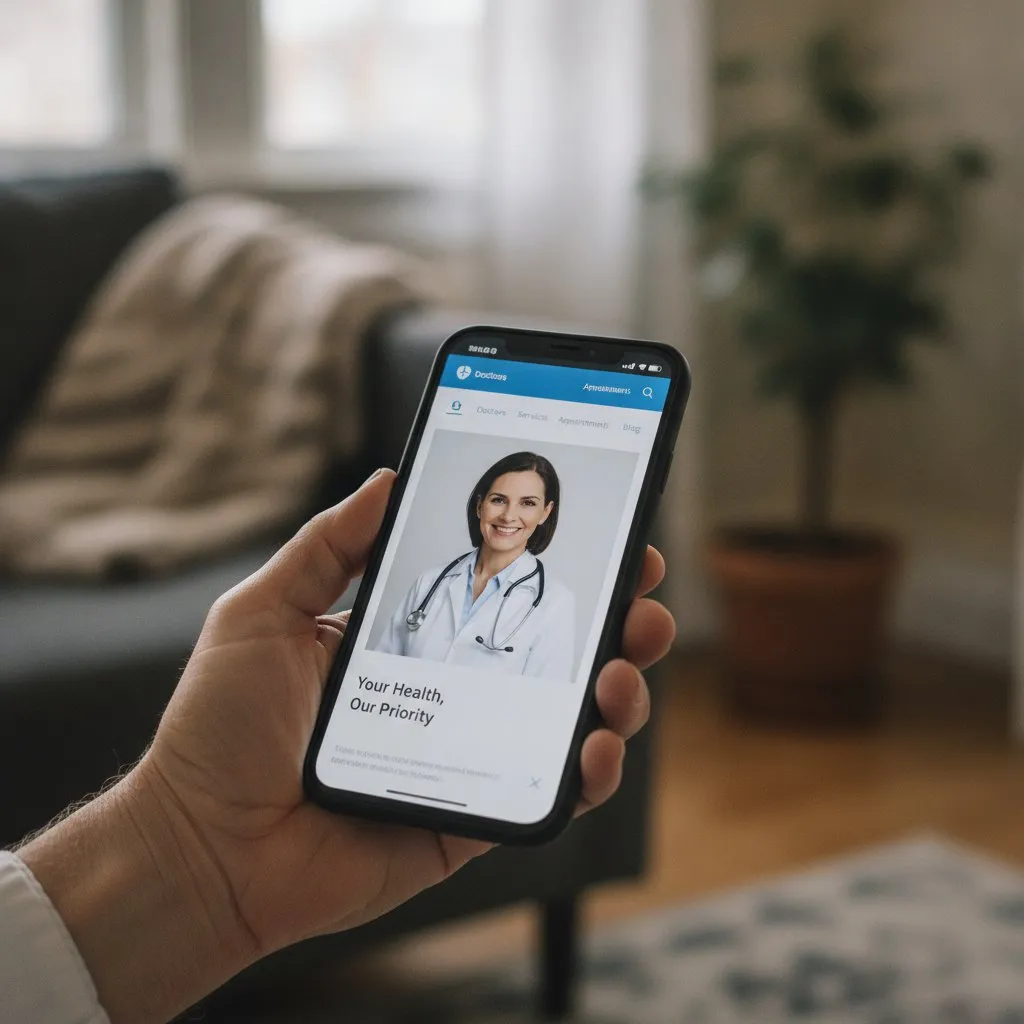
If you have a specific specialty, such as sports medicine, dermatology, pediatrics or geriatrics, then that must be immediately clear. A patient who has to click twice to discover whether you treat their complaint drops off. Clear labels, well-organized categories and clear texts work wonders here.
Why a standard template often falls short for medical practices
There are numerous cheap website builders and standard themes. For a hobby project, they are fine. For a medical practice, however, they quickly hit their limits. They offer insufficient customization for appointment modules, lack the right security layers, and do not always comply with the strict regulations surrounding patient data.
"A medical website is not a marketing brochure. It is a digital counter where patients come in with sensitive questions. Anyone who saves money on that with a fifty-euro template risks not only a bad first impression, but also legal and ethical problems."
Moreover, a template rarely offers support for the specific workflows of a practice. Think of multiple doctors in one group practice, separate calendars per discipline, returning patients who want to view their file or ask simple questions via a secure form. That requires customization that starts from your operations, not from a theme that you then try to bend.
What a doctors' website functionally really must be able to do
A professional website is not a digital museum. It must be an instrument that supports your daily practice management. Below are the core elements that are the norm today.
Making online appointments without hassle
Patients expect to be able to book an appointment at any time. A clear booking system that runs synchronously with your calendar saves your assistant dozens of phone calls per day and reduces errors in scheduling. It is important that the system also works flawlessly on mobile, because more than half of appointments are made in the evening from a smartphone.
Contact options and emergency procedures
Not every patient may simply book an appointment online. Sometimes it is better to have telephone contact first, or there must be a clear referral to emergencies. A good website makes that distinction without confusion.
| Patient need | What a weak site does | What a professional site does |
|---|---|---|
| Urgent question outside office hours | Only a phone number that does not answer | Clear referral to on-call service and emergencies |
| Making an appointment | Form that seems to go nowhere | Direct calendar link with confirmation email |
| Information about specialization | Vague description and outdated text | Separate pages per condition or treatment |
| Privacy and data processing | No mention or unclear disclaimer | Transparent privacy policy in accordance with GDPR |
| Practical info (address, parking, opening hours) | Hidden under three submenus | Always visible in the footer and on the contact page |
Speed and technical reliability in the healthcare sector
A patient looking for a doctor at night with pain complaints has no patience for a website that loads in eight seconds. Slow sites lose not only visitors, they also lose trust. Google measures this via the so-called Core Web Vitals, a series of technical performance indicators with which search engines assess the user experience. Those who do not pay attention to this drop in the rankings and disappear from view.
In addition to speed, technical reliability is also essential. No broken links, no outdated software, correct SSL certificates and a hosting environment that complies with Belgian and European regulations. These are not details, they are basic conditions. You can find more about this in our explanation on optimizing Core Web Vitals, where we go deeper into the technical side of fast websites.
Accessibility: not a side issue but a duty
The healthcare sector receives patients of all ages and backgrounds. People with a visual impairment, the hard of hearing, patients with reduced mobility and elderly people with reduced digital skills deserve a website that works for them. Yet in practice we still often see small print, insufficient contrast and buttons that are impossible to hit on a tablet.
Professional web design for doctors takes accessibility guidelines such as WCAG into account. That means, among other things, sufficient color contrast, text alternatives for images, keyboard navigation and clear focus indicators. Accessibility not only increases reach, it also reflects the caring attitude that patients expect from a medical practice.
Privacy and GDPR: where things often go wrong
Medical practices process special categories of personal data. That means stricter rules apply than for an ordinary business website. Contact forms, for example, may not request health information without the right security, and appointment modules must process and store patient data encrypted within the EEA.
What we often see: a website that thoughtlessly uses American cloud forms or tracking tools that forward patient data. That is not only a legal risk, it is also a breach of the trust that patients place in you. Professional web design means making conscious choices in the area of hosting, forms, cookies and integrations with your medical record.
Content strategy for medical practices
A website is never finished. Patients constantly ask new questions, medicine evolves and your practice changes. Those who view their website as a living instrument will reap the benefits in the long term. A strong medical content strategy consists of a few fixed pillars:
- Practical information: opening hours, address, accessibility, and what patients should bring to a consultation.
- Medical explanation: clear, non-confusing texts about conditions you treat, without making diagnoses.
- Practice news: new doctors, changed opening hours, temporarily different procedures.
- Patient stories or testimonials: of course only with explicit permission and fully anonymous where necessary.
- FAQ pages: the most frequently asked questions at the front desk, translated into an online answer.
This kind of content keeps the website lively, helps with search engine findability and reduces the number of phone calls to the practice.
How a professional website truly supports your practice management
We often hear that a doctor "has no time" for a website. Yet it is exactly the opposite: a good website gives time back. By correctly informing patients in advance and letting them book appointments online, more room remains for the medical work and less for administrative noise.
Fewer phone calls, more prepared consultations
If patients read in advance what a consultation entails, which documents they need to bring and how long an appointment lasts, they arrive better prepared. That shortens the consultation and increases the quality of care.
Better flow and planning
A website that is correctly linked to your calendar and to the work processes at the front desk ensures fewer double bookings, fewer no-shows and a smoother daily schedule. That is not a technical gimmick, that is essential operational progress. You can find more insight into how such optimizations affect results on our page Résultats du projet : hausse mesurable des leads.
Multilingualism: a Belgian reality
In Belgium, patients speak Dutch, French, German or English. In large cities and border municipalities, more languages are added. A professional website takes this into account, not by automatically translating everything, but by consciously choosing which languages are really needed and editing them professionally. A poorly translated website does more harm than a monolingual site that is correct.
For practices that want to offer multiple languages, it is also useful to provide a separate structure per language, so that search engines show the right version to the right target group. Feel free to see how our French-speaking counterpart approaches this at Belgique Web Design.
What you should ask a web design agency for the healthcare sector
Not every agency is suitable for a medical practice. The sector has specific requirements related to regulations, discretion and patient focus. Ask yourself and your supplier the following questions in advance:
- Does the agency already have experience with websites for doctors, dentists or clinics?
- How does it guarantee GDPR compliance for forms and appointment modules?
- Where is the website hosted and where is data stored?
- Can the website integrate with existing calendar or record packages?
- How does the agency provide long-term support, not only at delivery?
- Is the site technically monitored in terms of speed and updates?
- Is there a clear plan for content management and any multilingualism?
An agency that evades these questions or brushes them off with "we'll take care of that", is not a suitable partner for a medical environment. You can find an example of the depth we strive for on our blog about web design and software development in Belgium.
Pitfalls we often see in doctors' practices
In recent years we have viewed and rebuilt numerous medical websites. The same problems keep coming up:
- A website that is ten years old and that no one dares to touch.
- An abundance of medical jargon without explanation for patients.
- No mobile version or a mobile version that looks completely different.
- A contact form that never gets a response.
- Outdated photos of the practice or no photos of the team itself.
- Tables full of codes and abbreviations that mean nothing to patients.
Each of those points seems small, but together they form a website that patients do not trust and that does not correctly represent you as a professional.
Visual hierarchy: an underrated weapon in medical design
A patient lands on your site and within two seconds does not know where to look. That is not the patient's doubt, that is a design error. Visual hierarchy determines which elements stand out first and how the eye is guided through the page. In a medical context this is extra important, because you want to guide patients calmly toward the right action, without overwhelming them with stimuli.
A well-structured hierarchy means: a clear title, a calm resting space around it, a clear primary button, and only then the rest. If you want to go deeper into this, we recommend our contribution Hiérarchie visuelle en webdesign.
Imagery: from stock photos to distinctiveness
One of the fastest ways to distinguish a website is the use of your own, professional imagery. No generic photos of white coats in an American clinic, but real images of your practice, your team and your environment. Patients recognize the atmosphere that awaits them.
It is also important that photos are technically optimized. Heavy images slow down the site and cost visitors. You can find more explanation about this in our English-language contribution Image Optimization for Faster Sites. For the specific angle of the healthcare sector, we also gladly refer to Healthcare Web Design.
Cost versus real value: what does it deliver?
A professional website for a doctors' practice costs more than a template. That is true. But if you compare it with what half a page of advertising in a local magazine costs, or with what one hour of front desk work per day means in labor costs, then the bill already looks different. A website that works well pays for itself through fewer phone calls, better preparation of patients and a stronger position in local search results.
| Investment | Short-term effect | Long-term effect |
|---|---|---|
| Professional custom web design | Higher start-up cost | Strong position in search engines, less administration, more trust |
| Cheap template | Low entry cost | Outdated look, technical problems, hardly any findability |
| No website, only social media | No direct cost | No control, no findability, no credibility in the long term |
Anyone who works in the healthcare sector knows that trust is the most important capital. Your website is the digital face of that trust. Professional web design for doctors therefore means investing in something that brings patients to you day after day.
Digital solutions that go beyond a website
Sometimes a website alone is not enough. Group practices with multiple locations, clinics with complex calendars or practices that want to administer digital questionnaires often need custom software. Think of a patient portal where people can manage their appointments, request documents or request repeat prescriptions.
Such solutions require a partner who masters both web design and software development. With us, that often goes together: a website that seamlessly connects to a custom-built digital system. Anyone curious about that can view an example in our case about an ordering system for snacks and restaurants, where the same principle applies: user-friendly, reliable and designed around the customer.
Why the choice of an agency is so decisive
A doctor is not a marketer. That is not necessary either. But it is important to choose a partner who understands your sector. An agency that is used to serving webshops or advertising agencies often lacks the sensitivity for medical communication. At Ideal Design we work with small and medium-sized Belgian organizations, including medical practices, and we always start from the distinctiveness of the sector. You can find more about our approach on our page about the agency.
A final thought to take with you

A patient looking for a doctor today consults the screen first and only then the phone. Whoever leaves a calm, reliable and informative impression on that screen wins. Whoever makes a messy or outdated impression loses without a conversation ever having taken place. Professional web design for doctors is therefore not only a matter of aesthetics. It is a matter of trust, efficiency and patient-centered care, all brought together in one digital platform that represents your practice with dignity.
Would you like to check whether your current website still meets what patients expect today? A fresh look from an experienced team can reveal a surprising amount.