WordPress of Aangepaste Software ?
At the heart of every modern business strategy lies a crucial technological decision: do we build our digital presence on an existing platform like WordPress, or do we invest in custom software? This choice is much more than a technical detail; it is a fundamental decision that determines the future, security, and value of your company. Although WordPress is often praised for its accessibility and low entry costs, ambitious enterprises quickly hit the limits of this system. As your company grows, your needs change. You need specific workflows, unique customer interactions, and a level of security that an open-source platform simply cannot guarantee without countless workarounds. In this in-depth article, we analyze why the choice for custom software solutions is often the only logical step for companies serious about their online success and operational efficiency.
The Illusion of Ease: Why WordPress Doesn't Always Suffice
WordPress powers a large part of the internet, but popularity is not synonymous with quality, certainly not in a business context. The system was originally designed as a blogging platform and has been expanded over the years into a 'jack-of-all-trades'. However, as the saying goes: a jack-of-all-trades is a master of none. When you choose a standard CMS, you choose a system full of code you don't need. This is called "code bloat". Your server has to process thousands of lines of code that are totally irrelevant to your specific business goals, resulting in a slower website and a sluggish database. In an era where every millisecond counts for both Google and your user, this inefficiency is a costly burden.
Furthermore, with WordPress, you are extremely dependent on third-party 'plugins'. Do you want a specific functionality? "There's a plugin for that." But every plugin you install is a potential backdoor for hackers. You place your company's security and stability in the hands of unknown developers who might stop their updates or, worse, not secure their software properly. With custom development, on the other hand, every line of code is written with a specific purpose. There is no excess fat, no dependence on unreliable external parties, and no unnecessary complexity. It is a digital ecosystem designed purely and solely for your success.
Security as Top Priority: The Risks of Open Source
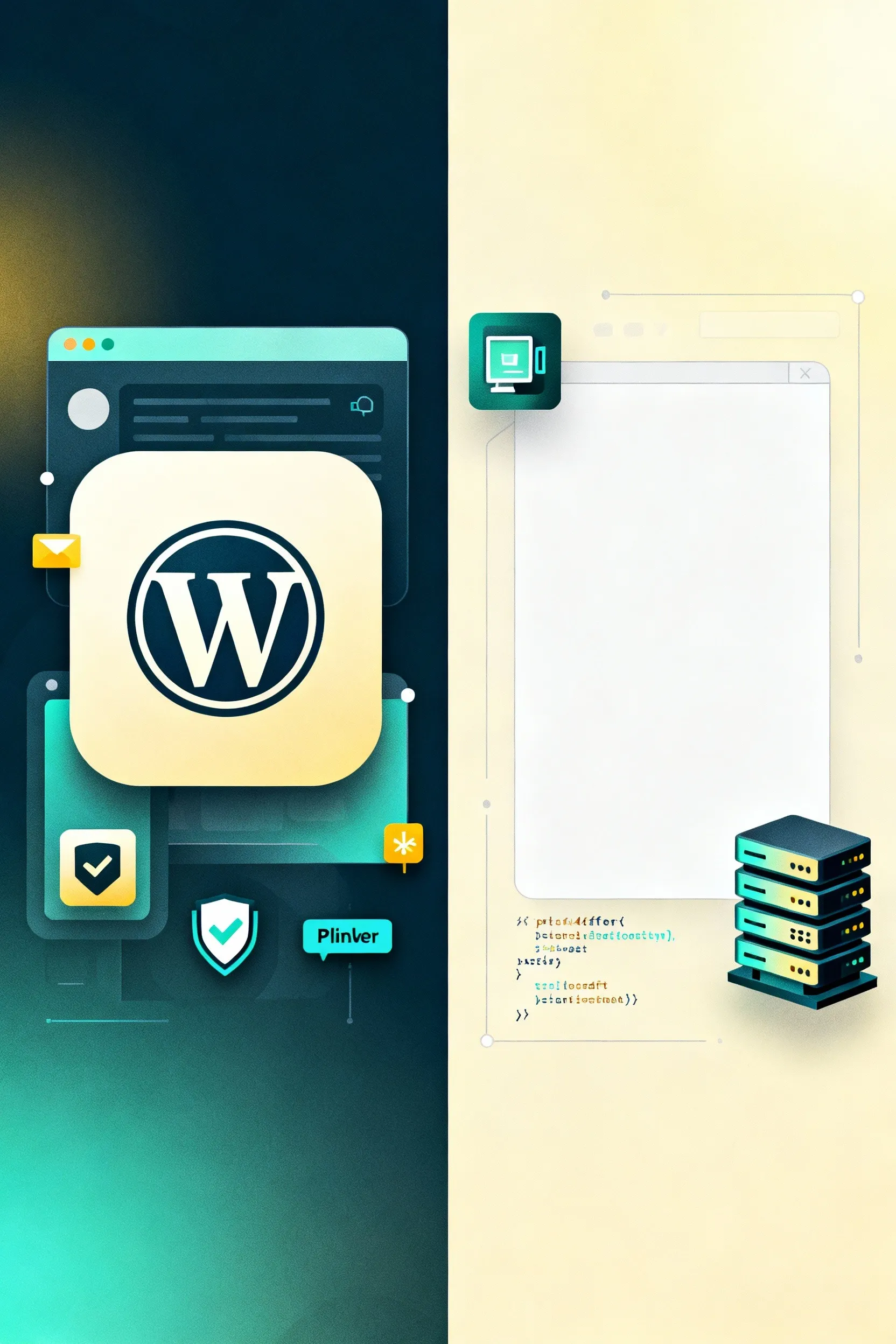 Security is by far the strongest argument for choosing custom software. Because WordPress is open-source, the source code is available to everyone – including hackers. They can analyze the code, find vulnerabilities, and write automated scripts to attack thousands of websites at once. It is no coincidence that WordPress sites are most often the victims of malware and hacks. You are constantly busy plugging leaks, updating themes, and hoping that one update doesn't break another.
However, if you choose proprietary software, your code is 'closed source'. A hacker doesn't know how your system is put together, what database structure you use, or where the administrative entry points are located. This "security by obscurity" principle, combined with robust, custom-made security protocols, makes your application an unattractive target for cybercriminals. For companies that process sensitive customer data or digitize complex internal processes via specialized management software, this level of security is not a luxury, but an absolute necessity in the context of GDPR legislation.
Speed and Performance: The Engine of Your Online Success
Imagine wanting to win a Formula 1 race with a modified city car. That is essentially what you do when you try to build a high-performance application on WordPress. You can tune the engine, add spoilers, and change the tires (plugins and caching), but the foundation remains a city car. Custom software is built from the ground up as a race car. The architecture is specifically designed to process your data as quickly as possible. No unnecessary scripts are loaded, and the database queries are optimized for your specific dataset.
This speed has a direct impact on your revenue. Users drop off with slow interfaces. But Google also mercilessly penalizes slow websites in search results. An efficiently programmed custom application ensures a lightning-fast user experience (UX). When we speak about professional web design, it's not just about how it looks, but mainly about how fast and smoothly it responds to user input. Custom work offers a performance advantage here that standard packages can hardly match.
Scalability and Future-Proofing
Every healthy company has the ambition to grow. But growth brings challenges. Your software must be able to handle more visitors, process more transactions, and integrate new functionalities. With a standard CMS like WordPress, you often hit a wall. The database becomes slow with large amounts of data, or the desired functionality is so specific that no plugin exists for it. You then still have to hire a developer to fight against the system and apply 'hacks' to get it working. This results in "spaghetti code" that is impossible to maintain.
Custom applications, on the other hand, are built with scalability in mind. From day one, future expansions are taken into account. Do you want to link your software to an external inventory system? Do you want a mobile app that communicates with your database? Or do you need advanced administrative software that integrates seamlessly with your website? With custom work, this is no problem. The architecture is flexible and modular. You are building an asset that grows with your company, instead of a limitation you have to replace every few years because you've outgrown it.
Total Ownership and Independence
An often overlooked aspect is ownership. When using commercial themes and plugins, you are essentially a tenant of functionality. You pay annual license fees, and if the developer decides to quit, you are left with a problem. With custom development, you are the full owner of the source code. You hold the intellectual property rights. This means you are not bound by third-party licenses and have complete control over your digital destiny. This significantly increases the value of your company in the event of a takeover or valuation.
Additionally, you eliminate "vendor lock-in". Although you want to maintain a good relationship with your development partner, clean, well-documented custom code (written in modern languages like Laravel, React, or Python) ensures that any professional developer can work with it. You are not dependent on the whims of a plugin developer abroad, but have firm control over your own platform.
Unique Brand Identity and User Experience (UX)
 In a digital world flooded by templates, differentiation is the key to standing out. A WordPress site, even with a 'premium' theme, often has a recognizable structure and look. The limitations of the theme dictate your design. With custom work, there are no limits. The design is shaped entirely around your brand identity and your customer's needs. You don't have to compromise because "the theme doesn't allow that".
This translates into a superior user experience. You can create workflows that align exactly with how your customers think and act. A quotation module that asks exactly the right questions? A customer portal where people can track the status of orders in real-time via connections with your other business software? Everything is possible. This unique experience ensures higher customer satisfaction and conversion. It shows that you are a professional player investing in quality, rather than a company choosing the cheapest, dime-a-dozen solution.
Long-Term Costs: The TCO (Total Cost of Ownership)
A frequently heard counterargument for custom work is the price. Yes, the initial investment for custom software is higher than installing a free CMS. But smart entrepreneurs look at the Total Cost of Ownership (TCO) over a period of 3 to 5 years. With WordPress, the hidden costs are often substantial:
- Annual license fees for premium plugins and themes.
- Costs for frequent maintenance and updates to plug security holes.
- Lost revenue due to slower load times or downtime.
- Costs for fixing hacks or conflicts after updates.
- Inefficiency in work processes because the software doesn't do exactly what you want.
With custom work, you pay for quality upfront. Maintenance is often much lighter because the code is stable and not dependent on constant third-party updates. Moreover, the efficiency gains and higher conversion often yield a much higher return on investment (ROI). Cheap is almost always expensive in the long run in the software world.
Integration: Connecting Your Business Processes
Modern companies work with a multitude of systems: accounting packages, CRM systems, ERP software, and marketing tools. The power of digitization lies in the seamless integration of these systems. WordPress can connect via APIs, but this is often a fragile process that breaks with updates. Custom software excels in this. It can function as the central hub of your organization.
Imagine: a customer places an order on your custom B2B portal. This order is immediately forwarded to your logistics software, the invoice is automatically generated in your accounting package, and the customer receives a notification via SMS. This level of automation saves hours of manual work and drastically reduces the chance of human error. This is where the real profit of custom work lies: it is not just a website, it is a tool for business optimization.
FAQ: Frequently Asked Questions about Custom Software vs. WordPress
Is custom software not much harder to manage myself?
On the contrary. With custom work, we build an administrator panel (CMS) that is exactly tailored to what you need. No thousand unnecessary buttons and menus like in WordPress, but a sleek interface where you easily manage your specific content. It is often much more user-friendly for your staff.
How long does it take to develop custom software?
This depends on the complexity, but count on a trajectory of several months. Quality takes time. However, due to the analysis and design phase, much time is saved in the future because fewer errors and adjustments are needed afterwards.
Is WordPress then never a good choice?
For a simple blog, a freelancer's portfolio, or a small informational site with a limited budget, WordPress can be fine. But as soon as processes, customer data, complex interactions, or high performance requirements come into the picture, it becomes a risk.
Is custom work better for my SEO?
Absolutely. Search engines love clean code, high speed, and a logical structure. With custom work, you have full control over technical SEO, without being hindered by the limitations of a theme or plugin.
What if I want to add extra functionality later?
That is the beauty of custom work; it is modular. You can start small (MVP - Minimum Viable Product) and add functionalities as your company grows and budget becomes available. The foundation is ready for it.